
Abstract
The overarching aim of the AURORA project is to qualify the CESAR1 solvent for commercial deployment. This is done through a dedicated qualification procedure [1], which ensures that important knowledge gaps are identified based on results from previous projects (e.g., CESAR, ALIGN-CCUS, and SCOPE) and closed through extensive pilot testing and solvent and process modelling and simulation. In a review article [2] based on open literature, the knowledge gaps related to modelling, degradation, solvent management, and pilot testing of the CESAR1 solvent were identified. Based on this, experiments in the lab related to solubility, kinetics, density and viscosity have been performed and improved models established. These models have implemented in the SINTEF inhouse simulator, CO2SIM.
The CO2SIM simulator provides a flexible and extensive simulation framework for solving a wide range of chemical processes related to CO2 capture technologies. It is a powerful tool for solvent development and preliminary design of solvent-based carbon capture plants. The former is enabled through the development of “soft models” for solvents for which limited data are available in the first stage of development or for complex system like the CESAR1 solvent which consists of two amines (AMP and piperazine) with a large variety in the individual properties. In brief, these soft models do not calculate species and a full equilibrium of all components, such as for example the NRTL model, although such models are available in CO2SIM also. It is an explicit equilibrium model primarily as function of temperature and bound CO2 in the solvent.
Within the AURORA project the model implementation has been revised and a new thermodynamically consistent mechanistic model approach based on full speciation is developed. Additionally, the enthalpy formulations have been updated enabling improved validity for a broader operating pressure in the stripper. These updates are briefly described in the following. More details will be given in the conference paper and in the presentation.
Keywords: post-combustion carbon capture; Amine based CO2 absorption, CESAR1 solvent; solvent modelling, VLE and kinetics
Authors: F. Andrew Tobiesena, Hanne M. Kvamsdala, Thor Mejdella, Karl Anders Hoff (SINTEF Industry).
New publication – The progress in solvent-based post-combustion CO2 capture in the last decade
Abstract Carbon dioxide emissions present a significant obstacle to mitigating climate change. Carbon capture, utilisation, and storage (CCUS) technologies, in…
Publication – Development of a Validated Rate-Based Model
Abstract In this work, we developed a new e-NRTL thermodynamic framework for CO2 absorption in aqueous mixtures of 2-amino-2-methyl-1-propanol (AMP)…
Publication – Pilot-scale CO2 capture in a cement plant with CESAR1
Abstract Carbon capture from hard-to-abate industries is essential. This study investigates the effect of stripper pressure on the performance of…
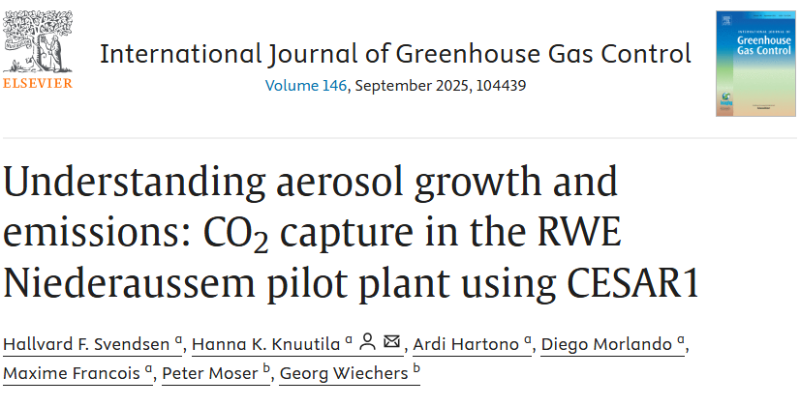
New Publication: Aerosol Modeling in CO2 absorption using CESAR1
We are proud to announce that Hallvard F. Svendsen, Hanna K. Knuutila, Ardi Hartono, Maxime Francois and Diego Morlando at…

Thermodynamic Properties of CO₂ Absorption in CESAR1 — Essential Data for Better Process Modelling
We are proud to announce a new scientific publication from the AURORA project, authored by Diego Morlando, Ardi Hartono and…
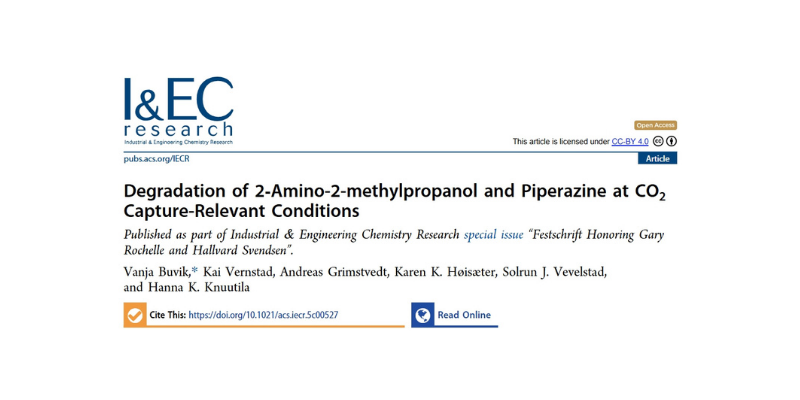
Journal Publication – In-Depth Study of CESAR1 Solvent Degradation Under CO₂ Capture Conditions
A new scientific publication based on research from the AURORA project has just been released in the journal Industrial &…
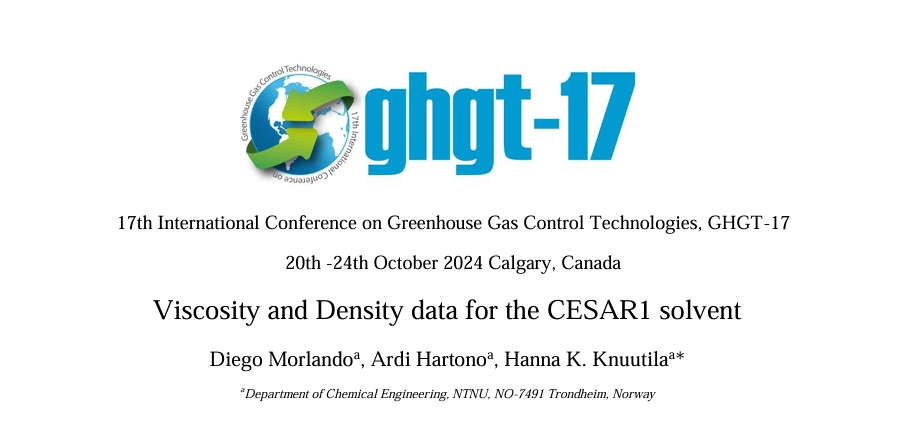
Conference publication – GHGT-17: Viscosity and Density data for the CESAR1 solvent
Abstract Global warming is a major issue that needs to be addressed and limited. The CESAR1 solvent blend has a…
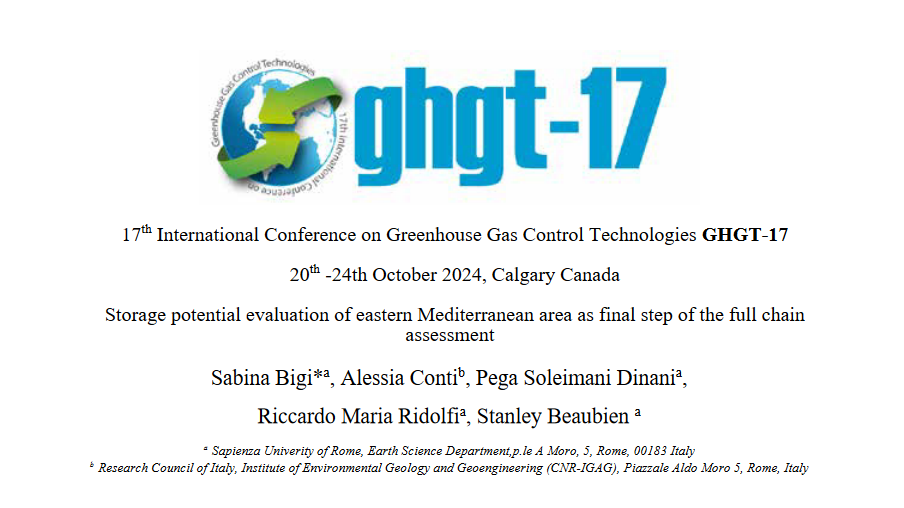
Conference publication – GHGT-17: “Storage potential evaluation of eastern Mediterranean area as final step of the full chainassessment”
The final step in capturing and storing carbon dioxide (CO₂) emissions is geological storage, where CO₂ is injected deep underground…
Understanding Solvent Degradation in CO₂ Capture – CESAR1 Solvent Degradation in Pilot and Laboratory Scale
The fight against climate change requires innovative solutions, and one promising method is CO₂ capture and storage (CCS). CCS involves…

Turning Waste Into Opportunity: Thermal Reclamation Chemistry of Common Amine Solvents
CO2 capture technology is vital for reducing greenhouse gas emissions. But what happens when the chemicals used in this process…