
Abstract
Growing global temperatures and human population lead to a constant increase in energy demand (Smit et al., 2014). Even with the growing energy supply from renewable sources, consumption of fossil fuels is inevitable in the future (Khaleel et al., 2022). Therefore, we should focus on technologies tackling CO2 emissions and transitioning towards net-zero carbon emissions until 2050 (Feron, 2016). Post-combustion CO2 capture (PCC) using absorption has emerged as the most mature technology to capture the emitted CO2 (Smit, 2016). Monoethanolamine (MEA) has been considered for many years as the benchmark solvent for its effective absorption capacity and low material cost (Bui et al., 2018). An aqueous blend of 3 M 2-amino-2-methyl-1-propanol (AMP) and 1.5 M piperazine (PZ) was found to outperform MEA in terms of energy performance and degradation stability (Feron et al., 2020; Morlando et al., 2024). Therefore, it has been proposed as the new benchmark solvent for this technology (Feron et al., 2020).
Keywords: MEA; CESAR1, ultra-high CO2 capture; Post-combustion CO2 capture; absorption.
Authors: Benas Mockusa, Diego Morlandoa, Hanna K. Knuutila (Department of Chemical Engineering, NTNU, Trondheim, Norway).
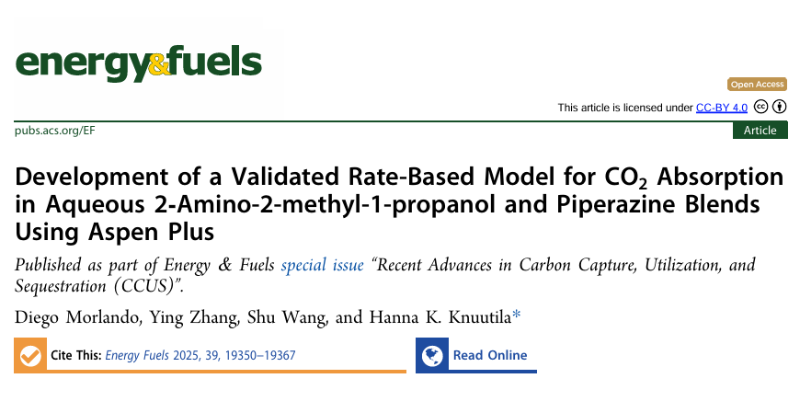
Publication – Development of a Validated Rate-Based Model
Abstract In this work, we developed a new e-NRTL thermodynamic framework for CO2 absorption in aqueous mixtures of 2-amino-2-methyl-1-propanol (AMP)…
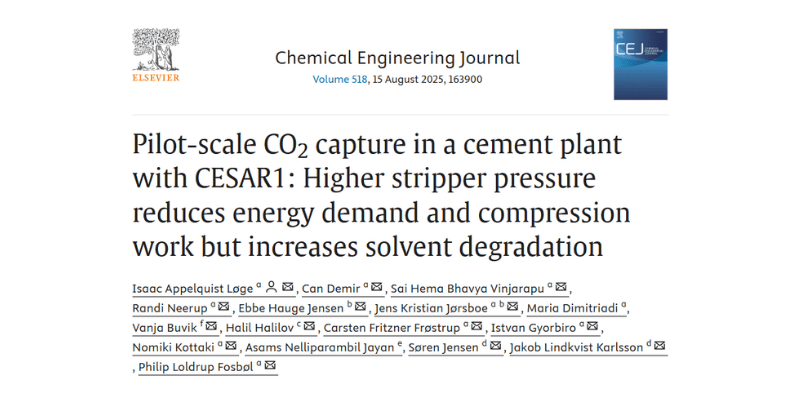
Publication – Pilot-scale CO2 capture in a cement plant with CESAR1
Abstract Carbon capture from hard-to-abate industries is essential. This study investigates the effect of stripper pressure on the performance of…
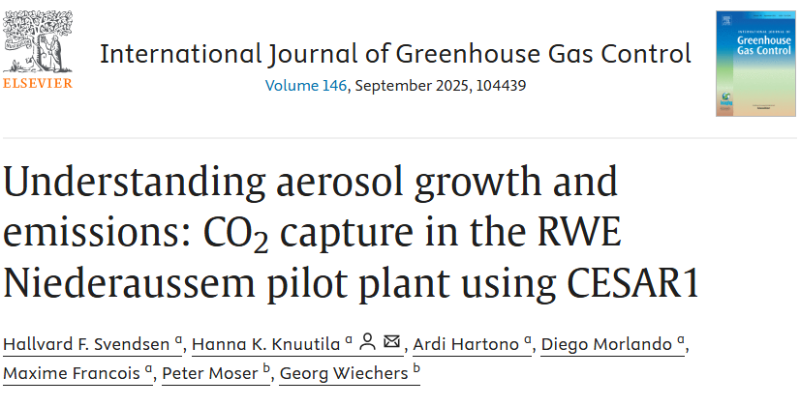
New Publication: Aerosol Modeling in CO2 absorption using CESAR1
We are proud to announce that Hallvard F. Svendsen, Hanna K. Knuutila, Ardi Hartono, Maxime Francois and Diego Morlando at…

Thermodynamic Properties of CO₂ Absorption in CESAR1 — Essential Data for Better Process Modelling
We are proud to announce a new scientific publication from the AURORA project, authored by Diego Morlando, Ardi Hartono and…
Journal Publication – In-Depth Study of CESAR1 Solvent Degradation Under CO₂ Capture Conditions
A new scientific publication based on research from the AURORA project has just been released in the journal Industrial &…
Conference publication – GHGT-17: Viscosity and Density data for the CESAR1 solvent
Abstract Global warming is a major issue that needs to be addressed and limited. The CESAR1 solvent blend has a…
Conference publication – GHGT-17: “Storage potential evaluation of eastern Mediterranean area as final step of the full chainassessment”
The final step in capturing and storing carbon dioxide (CO₂) emissions is geological storage, where CO₂ is injected deep underground…
Understanding Solvent Degradation in CO₂ Capture – CESAR1 Solvent Degradation in Pilot and Laboratory Scale
The fight against climate change requires innovative solutions, and one promising method is CO₂ capture and storage (CCS). CCS involves…

Turning Waste Into Opportunity: Thermal Reclamation Chemistry of Common Amine Solvents
CO2 capture technology is vital for reducing greenhouse gas emissions. But what happens when the chemicals used in this process…

Closing Knowledge Gaps – Density and Viscosity of Unloaded and CO2-loaded Aqueous AMP-PZ blends
AURORA’s latest scientific journal publication provides experimental density and viscosity data on different unloaded and CO2-loaded aqueous blends of 2-amino-2-methyl-1-propanol…